Voices in Tobiloba Awogbemila’s Rhythms of Home
By Osa Mbonu-Amadi
Amid the growing wave of violence and social unrest across different parts of the world, Nigerian painter and fine art photographer, Tobiloba Awogbemila, continues to engage audiences through artistic expressions that address pressing socio-cultural concerns.
In his latest body of work, titled “Rhythms of Home – Musical Collection,” Tobiloba draws inspiration from the worlds of music and law, creating pieces that not only entertain but also encourage viewers to reflect on the importance of cultural values, heritage, and positive societal ideals.
The collection serves as a powerful artistic statement advocating the preservation and promotion of Africa’s rich cultural traditions. Through painting and photography, the innovative artist presents compelling visual narratives that reflect everyday experiences and social realities.
Drawing from his legal training and his belief that “law and art are interconnected systems of observation,” Tobiloba transforms the gallery space into a symbolic courtroom. Works such as “No Witness” employ legal terminology and courtroom concepts, presenting paintings as exhibits, testimonies, and cross-examinations rendered on canvas.
Through his art, Tobiloba documents socio-cultural experiences, blending elements of law, language, and visual expression to create rhythmic narratives that extend beyond mere representation. In several works, trauma is portrayed as evidence, while cultural symbols repeatedly emerge through objects and imagery deeply rooted in tradition.
His celebration of cultural identity is particularly evident in the recurring depiction of Yoruba cultural instruments such as the talking drum, shekere, agogo, and bata, which serve as visual anchors throughout the collection.
By contrasting dark and light tones, the artist creates an atmosphere of calmness and reverence, filling the exhibition space with a sense of devotion and reflection.
Beyond their visual appeal, the artworks challenge audiences to engage more deeply with the themes presented, encouraging interpretations that go beyond the surface.
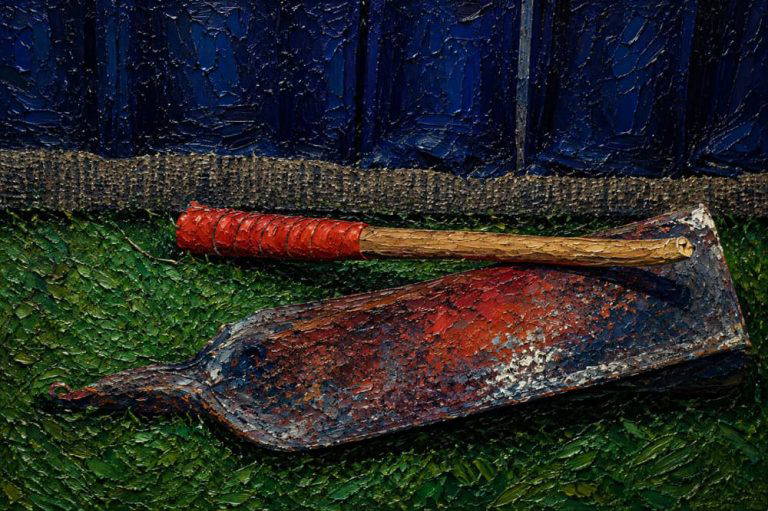
Using thick applications of paint that resemble layers of time, alongside depictions of hands on musical instruments and imagined performances, Tobiloba transforms memory into a lasting visual record of culture and communal life.
The collection also evokes ancestral presence and spiritual devotion through dominant shades of deep blue, creating a sacred environment populated with symbolic objects such as beads, ropes, gourds, and straps.
Throughout the series, musical instruments are personified and presented as witnesses. Beadwork, ropes, straps, and other cultural artifacts assume human-like roles within the compositions, becoming agents of memory, communication, and testimony. Notable works in the exhibition include “Voice of the Shekere,” “Drums of the Heart,” and “Shekere Family Tree.”
The artist’s use of layered paint reinforces the concept of memory as accumulated experience. In works like “Voice of the Shekere,” historical events are recalled through visual flashbacks, giving culture a tangible and enduring presence.
In this piece, silence itself becomes a form of expression. The shekere is depicted as motionless yet visually vibrant, creating the impression of lingering sound long after a performance has ended. The textured surface conveys the aftermath of significant cultural experiences and suggests a nostalgic remembrance of traditions that may no longer be actively practiced by younger generations.
In “Drums of the Heart,” Tobiloba transforms rhythm and melody into a communal language. The drums are arranged like members of a family gathered in conversation or celebration, inviting viewers into an engaging visual dialogue.
Similarly, “Shekere Family Tree” explores themes of lineage, family, and cultural continuity. Through the arrangement of beads, colours, and ascending forms, the artist emphasizes the family’s crucial role in transmitting cultural values across generations. The work reimagines cultural heritage as a living, evolving performance rather than a static possession.
Overall, “Rhythms of Home – Musical Collection” highlights cultural traditions preserved through visual art. Rather than romanticizing the past, Tobiloba documents musical instruments and cultural objects as symbols of continuity, interdependence, and social identity.
The artist places particular emphasis on communal instruments, reinforcing the idea that belonging is experienced through shared emotions, touch, memory, and collective bonds.
Legal themes remain prominent throughout the exhibition, especially in the “No Witness” series, where interrogations, evidence, and testimonies become artistic devices. Personal experiences, including trauma, are treated as exhibits that reveal how culture becomes embedded within objects, images, and recurring patterns.
Tobiloba’s signature blue palette appears deliberately applied with a palette knife, creating textured surfaces that immediately capture attention and contribute to the overall impact of the works.
Drawing inspiration from law, language, and art, “Rhythms of Home – Musical Collection” presents a body of work capable of engaging audiences from diverse backgrounds.
Combining the precision of photography with the perspective of filmmaking, the artist constructs each painting as a carefully staged scene, a reconstructed memory, and a historical archive.
His background in law, filmmaking, and photography is evident throughout the exhibition, as he skillfully weaves together documented narratives and reconstructed memories to explore multiple perspectives and voices.
In this collection, Tobiloba captures emotional and shared human experiences, transforming ordinary materials into symbols of cultural identity. Through the thoughtful use of colour, texture, and composition, he creates visual rhythms that echo celebration, memory, and cultural pride.
Both art enthusiasts and the general public are likely to find “Rhythms of Home – Musical Collection” relatable, as it reflects socio-cultural realities that resonate with contemporary life.
Ultimately, Tobiloba’s artistic vision is driven by themes of melody, ancestry, memory, and nostalgia. Those who view art as an essential expression of culture and identity will find his paintings richly textured, emotionally engaging, and deeply rewarding, as they seamlessly blend sound, memory, and visual storytelling in celebration of cultural heritage.