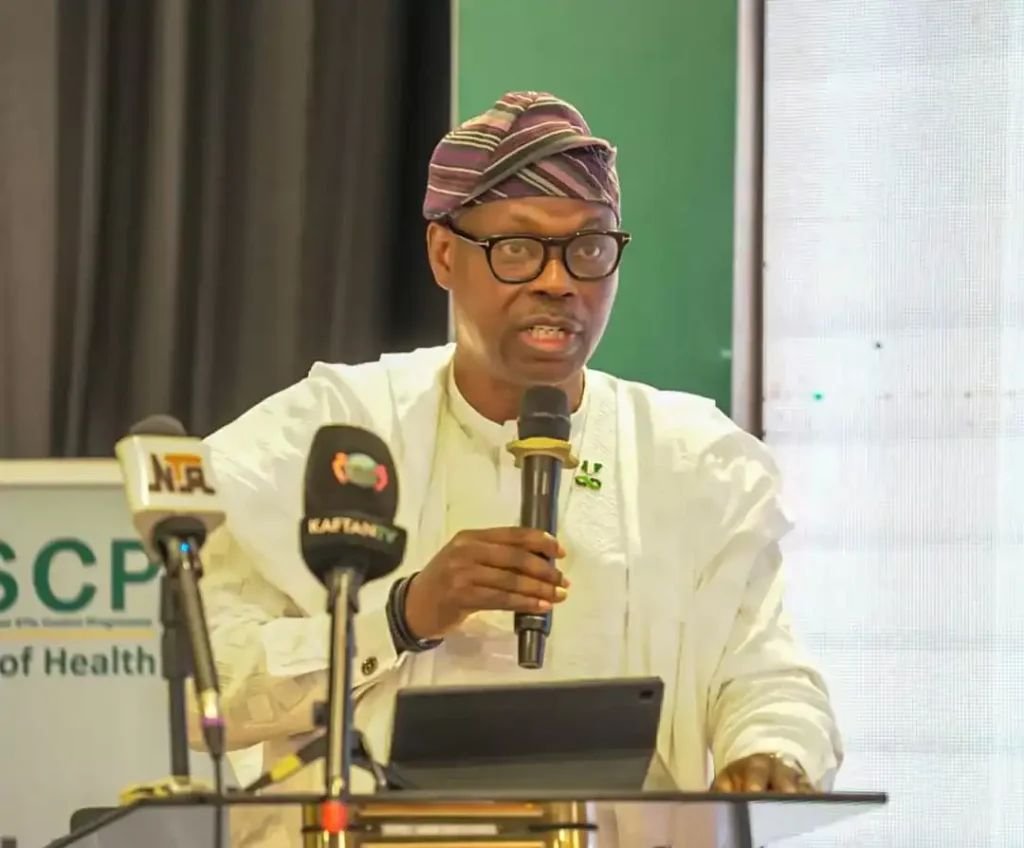
Poor maintenance crippling solar systems in health centres — Minister
Minister of State for Health and Social Welfare, Iziaq Salako, has said poor maintenance and the absence of clear responsibility for renewable energy installations are rendering some solar power systems in primary healthcare centres non-functional.
Salako stated in Abuja during the recent launch of the renewable asset management company by the Rural Electrification Agency, stressing that the Federal Government must move beyond the installation of solar systems to ensuring that the facilities remain functional over time.
The minister said the problem was not necessarily the technology but the failure to put in place preventive maintenance and clear responsibility for the systems after commissioning.
“Indeed, our ambition is not simply to install solar panels or batteries. Our ambition is to build a resilient health system where the electricity infrastructure powering our facilities functions today, tomorrow, next year, and for many years to come. And that brings me to why RAMCO matters to that sector and why I regard today as a health milestone as much as an energy one.
“Evidence from solar systems installed in Nigerian PHCs shows that over 30 per cent become non-functional within a few years.
It is rarely the technology; it is the absence of scheduled preventive maintenance, the absence of anyone holding a clear mandate once the commissioning ends,” he stated.
Salako said sustainable maintenance arrangements must be incorporated into renewable energy projects from the outset rather than treated as an afterthought, saying, “Such scenarios must become part of the project from the first day, not an afterthought.”
He explained that the Federal Government’s Power for Health Initiative was designed to address the electricity challenges facing health facilities and ensure that renewable energy investments remained productive.
According to him, the initiative would work with the Renewable Asset Management Company to ensure that renewable energy installations were properly managed throughout their lifespan, adding that a solar plant ceases to be a project that can end and become an asset that can endure.
The minister said reliable electricity was critical to healthcare delivery, describing power as a clinical necessity rather than merely an infrastructure requirement.
“In a hospital, electricity isn’t merely an amenity; it is a clinical necessity. It is the core thing that keeps patients protected,” he said.
He noted that power failures in health facilities could have serious consequences for patients, particularly in critical care and maternity services.
The minister disclosed that between 60 and 70 per cent of primary healthcare centres in Nigeria experienced frequent power outages or had no electricity, while many tertiary hospitals received only limited hours of grid supply daily.
He added that some tertiary health facilities spent between 40 and 50 per cent of their operating expenses on energy, much of it on diesel.
As a result, President Bola Tinubu approved the Power for Health Initiative, targeting steady electricity for at least 30 per cent of health facilities in Nigeria by the end of 2027.
He said the Power for Health Initiative would require collaboration between the Federal Ministry of Health and Social Welfare, the Federal Ministry of Power, the Rural Electrification Agency, subnational governments, the private sector, development partners and civil society.
He also said the Federal Ministry of Health and Social Welfare would work with the renewable asset management company to ensure that energy assets in health facilities had clear custodianship, maintenance arrangements and reliable performance standards.