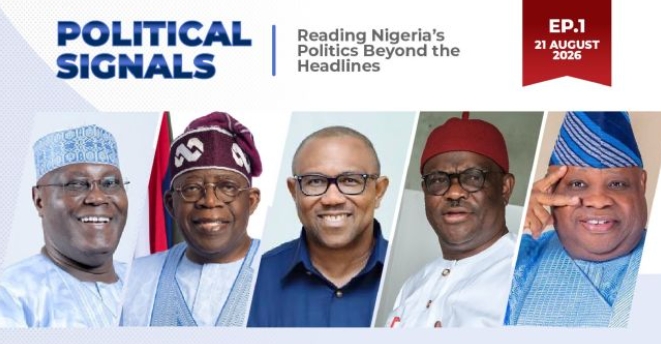
The Political Chessboard Is Moving
The formal campaign for the 2027 presidential election began this week, with President Bola Ahmed Tinubu seeking a second term and opposition figures attempting to consolidate behind a common challenger
Nigeria entered the formal campaign season this week.
But perhaps the more interesting development is what happened around the campaign.
The opposition is attempting to construct a coalition capable of defeating President Bola Ahmed Tinubu.
At the same time, forces within and around the ruling establishment are working on a coalition of their own.
Suddenly, the political conversation is no longer simply:
TINUBU VS THE OPPOSITION
It is becoming:
WHO CAN ASSEMBLE THE BROADEST POLITICAL COALITION BEFORE NIGERIANS CAST THEIR VOTES?
That may prove to be the defining question of 2027.
THE BATTLE FOR THE COALITIONS HAS BEGUN
The formal campaign for the 2027 presidential election began this week, with President Bola Ahmed Tinubu seeking a second term and opposition figures attempting to consolidate behind a common challenger.
The APC enters the contest with considerable structural advantages.
The party now controls 31 of Nigeria’s 36 governorships, giving it an extensive political and organisational network.
The opposition, meanwhile, has something the APC cannot manufacture:
Public dissatisfaction.
Economic hardship and insecurity remain major concerns for many Nigerians.
But dissatisfaction with an incumbent is not the same thing as support for an alternative.
That distinction may ultimately decide 2027
The most revealing development of the week may be the language of coalition.
The opposition is seeking a common platform.
But forces supporting President Tinubu are now talking openly about a broader political alliance.
FCT Minister Nyesom Wike has described a “massive Rainbow Coalition” as emerging in support of the President’s re-election.
The symmetry is striking.
The opposition is trying to build a coalition to defeat Tinubu.
Tinubu’s allies are trying to build a coalition to make defeating him much harder.
This may be more consequential than the daily political exchanges between the parties.
The 2027 election could ultimately be won or lost in the negotiations taking place behind the scenes.
WINNER OF THE WEEK
NYESOM WIKE
Wike’s significance this week is not simply what he said.
It is the fact that he has positioned himself at the centre of the conversation about the shape of the 2027 political coalition.
His announcement of a proposed Rainbow Coalition has put the question of cross-party realignment firmly on the national agenda.
Whether the coalition can actually deliver votes remains to be seen.
But politically, Wike has succeeded in making himself relevant to the emerging architecture of the election.
POLITICAL MOMENTUM: ↑
WINNER OF THE WEEK
ADELEKE
Ademola Adeleke has had an extraordinary political week.
He won re-election in Osun, defeating the APC candidate.
But the significance of the victory goes beyond the result itself.
Within days, Adeleke was meeting President Tinubu and subsequently Wike.
Wike has publicly claimed Adeleke as part of his political camp, while Adeleke’s camp has characterised his engagement with Tinubu as a courtesy rather than a political defection.
Whatever the ultimate political meaning, one thing is clear:
winning an election increases political bargaining power.
For now, Adeleke has options.
POLITICAL MOMENTUM: ↑↑
LOSER OF THE WEEK
THE IDEA THAT 2027 IS ALREADY DECIDED
The APC remains extraordinarily powerful.
But Osun has punctured the notion that its dominance makes the 2027 presidential election inevitable.
The lesson is not that the APC is weak.
It clearly isn’t.
The lesson is that:
Political dominance creates advantage. It does not eliminate voter choice.
Osun is one state. A governorship election is not a presidential election.
But it is a useful reminder that Nigerian voters can still surprise the political establishment.
THE BIGGER STORY
THE RISE OF COALITION POLITICS
There is a striking symmetry emerging.
The opposition is discussing a single presidential candidate.
The G-100 has been urging opposition leaders to unite.
And now Wike is talking about a large coalition behind President Tinubu.
Everyone appears to have reached the same strategic conclusion:
2027 may be won by whoever constructs the most effective political alliance.
Traditional party labels may therefore become less important than the personalities, structures and interests assembled behind each presidential candidate.
SOUTH-WEST
The APC remains structurally strong.
But Osun has demonstrated that the region cannot simply be treated as politically guaranteed.
The question is whether the opposition can reproduce the Osun formula elsewhere—or whether Adeleke’s victory was primarily a local phenomenon.
SOUTH-EAST
Peter Obi remains the major political factor.
His challenge is to convert considerable enthusiasm into a broader national coalition.
SOUTH-SOUTH
This could become one of the most fascinating theatres of 2027.
Wike’s influence and the possibility of cross-party alliances could make the region particularly important.
NORTH-CENTRAL
Potentially decisive.
The region could become the bridge between competing Northern and Southern coalitions.
NORTH-WEST & NORTH-EAST
The great electoral prize.
Population and voting strength make the North indispensable to any presidential coalition.
The opposition’s ability—or inability—to combine different Northern and Southern constituencies could become decisive.
THE STRATEGIC QUESTION
CAN THE OPPOSITION BUILD ONE COALITION BEFORE TINUBU’S COALITION IS COMPLETE?
Atiku brings experience and established political networks.
Obi brings considerable popular enthusiasm, particularly among younger and reform-oriented voters.
Other political actors bring regional structures and influence.
On paper, the combination is formidable.
But personalities do not automatically add up to votes.
And votes do not automatically add up to a winning coalition.
The opposition must create something much more difficult than a political agreement:
A shared political identity.
Until that happens, the arithmetic remains theoretical.
The Adeleke Question
IS OSUN’S WINNER NOW A SWING POLITICAL ASSET?
This is one of the most intriguing questions raised this week.
Adeleke has just demonstrated that he can defeat the APC in a strategically important South-West state.
He is now being discussed by actors across the emerging political divide.
But we should distinguish between:
what politicians say,
and
what the evidence establishes.
Wike’s assertion that Adeleke belongs to his political camp is a political statement—not proof of Adeleke’s future alignment.
That distinction matters.
Political Signals will watch actions, not speculation.
QUOTE OF THE WEEK
“A massive Rainbow Coalition.”
— Nyesom Wike
The phrase is less important than the strategy behind it.
If such a coalition materialises, the APC could enter 2027 with a political base considerably broader than its formal party membership.
But one question remains:
Can political endorsements and defections be converted into actual votes?
That is what we will be watching.
THE NUMBER OF THE WEEK
31
The number of Nigeria’s 36 governors currently belonging to the APC.
It explains why President Tinubu remains the candidate to beat.
But Osun explains why the number should not be mistaken for electoral certainty.
WHAT TO WATCH
01 — THE RAINBOW COALITION
Who actually joins it?
And, more importantly, what political structures do they bring?
Announcements will matter less than the identities and organisations behind them.
02 — THE OPPOSITION’S SINGLE CANDIDATE
Can Atiku, Obi and the other opposition actors agree on one presidential candidate?
This remains the biggest unresolved question.
03 — ADELEKE’S NEXT MOVE
Does he remain within the political space from which he emerged, or does he become part of a broader national realignment?
Watch actions, not speculation.
04 — THE ECONOMY
Political manoeuvring will dominate the headlines.
But Nigerians will ultimately vote on lived experience.
Food prices, purchasing power, employment and security may matter more than any political declaration.
POLITICAL SIGNAL
COALITION VS COALITION
The defining development of this week is not simply that the opposition is trying to unite.
It is that the ruling side is preparing for the same game.
That changes the calculation.
The 2027 election may ultimately be less about the strength of individual parties and more about which side can build the broadest, most credible and most disciplined national coalition.
THE BOTTOM LINE
President Tinubu remains the candidate with the stronger structural position.
The APC controls an extraordinary number of state governments, possesses incumbency and has a substantial political organisation.
But this week has demonstrated two things that should temper any assumption of an easy victory.
First, the APC can still be defeated.
Osun has demonstrated that.
Second, the opposition is not the only side capable of coalition building.
Wike’s declaration of a coming Rainbow Coalition suggests that the political establishment is already moving to widen the President’s electoral base.
The opposition therefore faces an uncomfortable race against time.
It must construct its coalition while the governing side is constructing its own.
And somewhere between these competing coalitions lies the Nigerian voter.
The ultimate question will not be who can assemble the longest list of politicians.
It will be:
WHO CAN ASSEMBLE THE COALITION THAT NIGERIANS ACTUALLY BELIEVE IN?
That is the political signal this week.
EDITORIAL NOTE
Political Signals is an independent weekly political analysis produced for Channels Television. It examines political developments, personalities and electoral trends without endorsement of any political party or candidate. Its assessments are based on publicly available evidence and may change as events and evidence develop.