The peace accord illusion: Why Nigeria keeps preaching peace while violence persists
BY OLUFEMI ADUWO
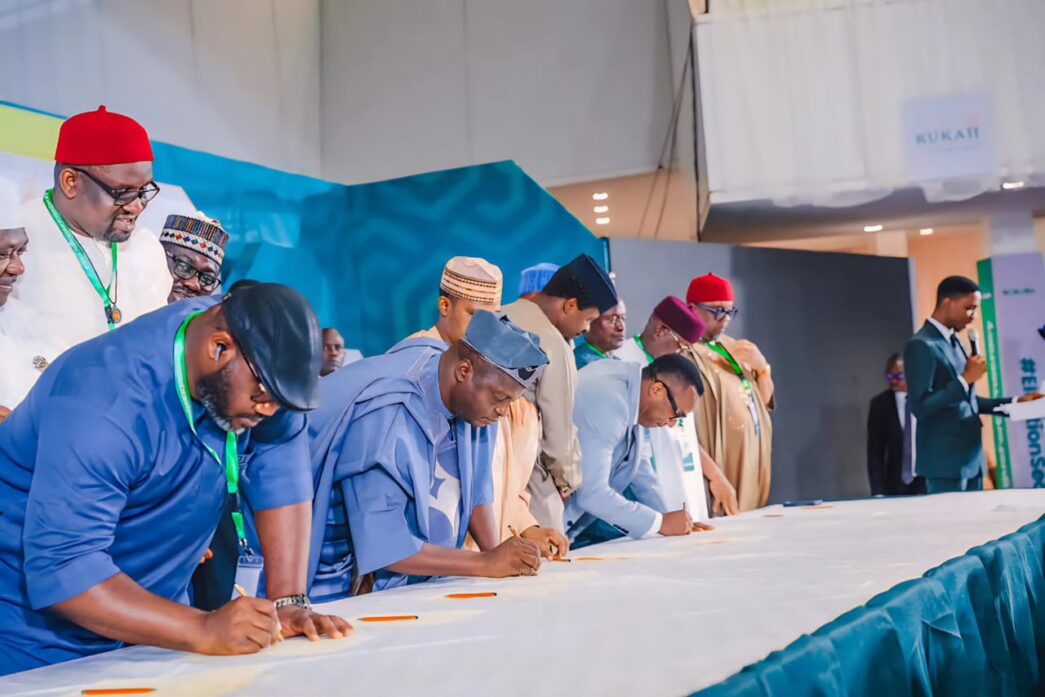
There is something profoundly paradoxical about Nigeria’s electoral democracy: we have become remarkably proficient at signing peace accords, yet conspicuously unsuccessful at producing peace. With every election cycle comes the familiar ritual. Political gladiators assemble before eminent statesmen, religious leaders and diplomats; solemn speeches are delivered; candidates shake hands before television cameras; documents are signed; photographs are taken; and the nation is assured that political actors have committed themselves to peaceful elections. Yet, almost as predictably, the combatants return to their trenches, inflammatory rhetoric resurfaces, political thugs are mobilised, and Nigerians are left to count the casualties.
The National Peace Committee emerged in 2014 against the backdrop of mounting tensions ahead of the 2015 general elections. It was initiated under the leadership of former Head of State, General Abdulsalami Abubakar, with Catholic Bishop Matthew Hassan Kukah as Convener, alongside other eminent Nigerians. Its purpose was to provide a credible platform through which political actors could publicly commit themselves to peaceful campaigns, restraint and respect for electoral outcomes.
The first major national Peace Accord was signed ahead of the 2015 presidential election by President Goodluck Jonathan and then presidential candidate Muhammadu Buhari. It was a commendable intervention at a moment when fears of post-election violence were widespread. President Buhari subsequently acknowledged that the accord had contributed to the relatively peaceful conduct of the 2015 election.
But an initiative can be commendable without being sufficient. After more than a decade of Peace Accords, Nigeria should move beyond symbolism and interrogate the evidence. Has the ritual of signing agreements actually reduced electoral violence in any meaningful or sustainable way? The answer is, at best, ambiguous.
There is no single authoritative national database providing a definitive cumulative figure for all deaths arising from electoral violence since the Peace Committee began its intervention. Different organisations employ different definitions, geographical parameters and timeframes. Some count only violence occurring on election day, while others include politically motivated killings during campaigns and the post-election period.
Nevertheless, the available evidence is disturbing. For the 2015 electoral cycle, the Nigeria Security Tracker documented 106 election-related deaths, including 62 fatalities in the months preceding the election and another 44 afterwards. For the 2019 elections, the European Union Election Observation Mission recorded approximately 145 deaths associated with election-related violence during the campaign period and the three election days, while other Nigerian monitoring organisations, using broader timeframes, produced significantly higher figures.
The 2023 electoral cycle was similarly marred by violence. The European Union Election Observation Mission recorded 101 violent incidents during the campaign, resulting in at least 74 fatalities, while other monitoring organisations recorded additional deaths across the wider electoral period. The precise cumulative figure therefore depends on the methodology employed, but even the more conservative comparable figures demonstrate that hundreds of Nigerians have lost their lives in election-related violence since the National Peace Committee began its work.
That reality deserves serious contemplation. If Peace Accords have been repeatedly signed since 2015, why does electoral violence remain such a stubborn feature of Nigerian politics? Perhaps we have confused the ritual of peace with the architecture of peace.
The recent Osun governorship election provides an especially contemporary test. Political parties and candidates signed a Peace Accord before the 15 August 2026 governorship election, with the stated objective of securing commitments to peaceful campaigns and a violence-free poll. Yet the signing did not eliminate political violence.
Ahead of the election, civil-society monitoring organisations reported numerous incidents of electoral violence, including fatalities. There were also allegations of inflammatory rhetoric, intimidation and threats. The police summoned Senator Francis Fadahunsi over a viral statement allegedly urging supporters to kill members of the Accord Party, an allegation he was required to explain. On election day, there were also reports of voters fleeing some polling locations and electoral materials being destroyed by hoodlums.
The significance is not that the Peace Accord caused the violence; such a conclusion would be intellectually indefensible. Rather, the episode demonstrates something more fundamental: a signed document cannot, by itself, neutralise the political incentives that generate violence. The Osun experience reinforces a broader Nigerian reality: agreements may create an atmosphere for dialogue, but they cannot substitute for effective institutions, credible enforcement and an electorate sufficiently empowered to resist manipulation.
Nigeria does not suffer from a shortage of declarations. We have constitutional safeguards, electoral legislation, codes of conduct, security agencies, judicial remedies, election observers, civil-society organisations and, increasingly, an impressive archive of Peace Accords. What remains deficient is credible enforcement.
A politician who sponsors, finances or incites violence must know that the consequences will be swift, certain and sufficiently serious to outweigh the political benefits. At present, that deterrent is often missing. The political entrepreneur may therefore calculate that intimidation, inducement and violence are worth the risk if they increase the probability of electoral victory.
That is the real problem. A solemn document cannot restrain a politician who regards political power as an existential possession. A handshake cannot disarm a political thug. A bishop cannot prosecute a killer. A retired general cannot arrest the sponsor of electoral violence. Nor can a ceremonial gathering substitute for an impartial police force, credible prosecution and a judiciary capable of delivering timely justice.
Nigeria’s electoral reform conversation should therefore devote far greater attention to voter education. The Nigerian voter must understand that a ballot is not a commodity to be exchanged for a few thousand naira, a bag of rice or a temporary inducement. Vote-buying is not generosity; it is political investment.
A politician who spends enormous sums purchasing electoral support will eventually seek to recover that investment through patronage, inflated contracts, corruption and the capture of public resources. Voter education must therefore become as central to democracy as voter registration. Citizens should be taught how to scrutinise manifestos, distinguish policy from propaganda, understand the constitutional responsibilities of elected officials, recognise political incitement and demand accountability from those they elect.
Most importantly, Nigeria should begin a serious national conversation about compulsory voting. The idea may initially appear radical, but compulsory voting is hardly alien to democratic practice. Australia requires eligible citizens to participate in elections. Belgium has compulsory voting provisions for citizens aged 18 and above, while Brazil also operates a compulsory voting system, subject to legal exemptions and procedures. Argentina and several other democracies have adopted similar arrangements.
Compulsory voting does not mean compulsory support for a particular candidate. It means compulsory participation in the democratic process, with appropriate exemptions for legitimate circumstances and, where the law permits, the option of casting a blank or protest ballot.
Nigeria should examine the possibility of introducing such a system for citizens aged 18 and above, accompanied by appropriate exemptions for illness, disability, emergencies and other legitimate circumstances. The objective would not be coercion for its own sake, but to enlarge democratic participation and diminish the capacity of politicians to manipulate a relatively small electorate.
The logic is straightforward. Where voter turnout is chronically low, politicians have a smaller electorate to target. Vote-buying, intimidation and mobilisation of partisan blocs therefore become easier. But imagine a Nigeria in which 70, 80 or even 90 per cent of eligible citizens participated in elections. The political arithmetic would change substantially.
A politician could no longer rely upon purchasing a narrow segment of the electorate and converting that investment into victory. Candidates would have to persuade a much broader and more diverse constituency: farmers, traders, students, professionals, artisans, pensioners, women and young people.
Nigeria’s most consequential Peace Accord should therefore not be between politicians. It should be between the Nigerian citizen and democracy. The citizen should make a simple commitment: I will vote. I will not sell my vote. I will reject political violence. I will demand accountability from whoever I elect. The state, in return, must make an equally solemn commitment: We will protect the voter, safeguard the ballot, count the votes honestly and punish those who attempt to subvert the democratic process.
General Abubakar, Bishop Kukah and the distinguished members of the National Peace Committee deserve recognition for their efforts. Their interventions have provided an important platform for dialogue and de-escalation, particularly at moments when political tensions have threatened to spiral out of control. But after more than a decade, Nigeria must be sufficiently courageous to distinguish symbolism from substance.
Peace Accords may help create a climate for restraint, but they cannot, by themselves, produce peace. Sustainable peace is ultimately produced by credible institutions, civic education, justice, political accountability, effective law enforcement and an electorate sufficiently large and informed to make manipulation increasingly difficult.
Let politicians continue to sign their accords. Let the cameras capture the handshakes. Let eminent statesmen deliver their solemn exhortations. But Nigeria must now concentrate on the deeper work of democracy: educating the voter, empowering the citizen, expanding participation and making electoral violence politically and legally prohibitively costly.
After more than a decade of experience, the uncomfortable conclusion is difficult to avoid: the Peace Accord has been signed repeatedly, but peace has remained unsigned. Nigeria therefore needs less ceremony and more civic empowerment; fewer symbolic handshakes and stronger institutions; fewer declarations of peace and greater consequences for those who destroy it.
In the final analysis, an accord does not bring peace. An informed, empowered and sufficiently numerous electorate does.
Olufemi Aduwo is the permanent representative of the Centre for Convention on Democratic Integrity (CCDI) to the United Nations Economic and Social Council (ECOSOC). He can be contacted via olufemi.aduwo@ccdiltd.org