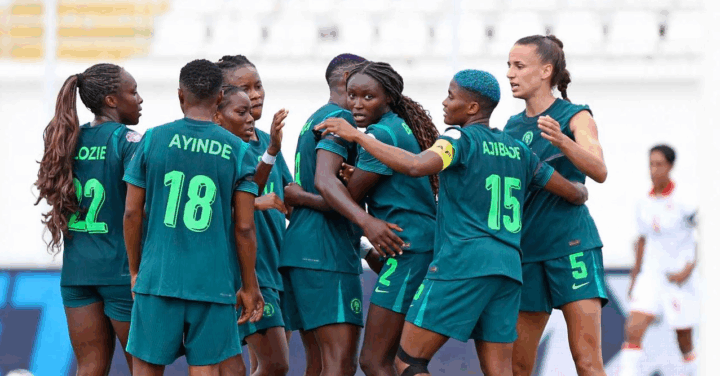
She can score goals and raise children: Ending the motherhood penalty in Nigerian football
BY EMMANUELLA CHISOM ONONENYI
On the 24th of July, during my regular scrolling through various news publications, I came across a headline that immediately caught my attention and deeply unsettled me.
It read: “Former Nigeria international Ngozi Okobi-Okeoghene has claimed many female footballers in the country are afraid to get married or start families because they fear it could end their international careers.
The headline compelled me to open the article and read further. As I delved into the story, I found myself deeply disturbed and increasingly curious about why Nigerian female footballers would fear that marriage or motherhood could cost them their careers.
That curiosity led me to read extensively on the intersection of motherhood and football, particularly within the Nigerian context. As I analysed the state of Nigerian football in relation to motherhood, my research naturally extended to a comparative analysis of football systems in other jurisdictions.
What I discovered was both revealing and disquieting. Beneath the surface of the game lies a deeply entrenched patriarchal culture that quietly shapes opportunities, career progression, and the lived experiences of female footballers.
However, I must also acknowledge that my research revealed a more encouraging reality in some jurisdictions, particularly across parts of Europe, where football institutions have adopted more family-friendly and inclusive policies that better support married players and nursing mothers.
In the world of work, mothers are often confronted with multiple stereotypes. They are perceived as being less suited for leadership roles, considered less competent than their peers, paid less, and, in many cases, denied promotions and other opportunities for career advancement.
If we pause for a moment to reflect on these stereotypes faced by women who choose to become mothers, we will realise that they are largely products of societal conditioning rather than objective realities.
Over the years, there have been significant advancements in the way different sectors and industries operate. Yet, one factor has remained stubbornly resistant to change across many workplaces:
unfair career development policies and practices driven by gendered norms and deeply rooted cultural stereotypes. Unfortunately, many workplaces continue to be structured around men’s experiences, valuing traditionally masculine attributes and reinforcing conventional notions of leadership.
In doing so, they create systems that inadvertently—or, at times, deliberately—exclude mothers from progressing and thriving within these patriarchal environments.
This reality is particularly evident across many African countries, including Nigeria, where numerous workplaces still lack adequate family-friendly policies. Paid maternity leave is often limited or non-existent, workplace support for nursing mothers remains inadequate, and many organisations fail to provide conducive environments that enable women to balance motherhood with their professional responsibilities. Some may argue that such policies are unnecessary. Others may ask, “Why should employers bear the burden of another person’s decision to have a child?” However, amid this ongoing debate about whether mothers belong in the home or the workplace, we must not lose sight of a more fundamental question: how does motherhood shape a woman’s career progression, access to leadership, and opportunity to contribute meaningfully to society? That question deserves not only critical examination but also empathy.
Considering the largely unquestioned expectation of uninterrupted career progression, it is unsurprising that mothers remain markedly underrepresented in leadership positions. At the heart of this disparity lies the motherhood penalty—the persistent assumption that mothers are less committed to their careers than their non-mother or male counterparts. This perception often translates into delayed promotions, exclusion from career-enhancing opportunities and leadership pathways, particularly in highly competitive fields such as sports, and the pressure to make difficult decisions that may ultimately undermine their professional growth in order to meet the needs of their children. More often than not, these outcomes are not a reflection of a mother’s competence or ambition. Rather, they stem from the absence of inclusive workplace policies, inadequate institutional support, limited support systems at home, or, in many cases, a combination of all three.
In the context of how motherhood impacts careers, female athletes are by no means excluded from this discussion. Indeed, many professional sportswomen find themselves standing at the intersection of two deeply significant aspirations: sport and motherhood. For many, choosing the path of motherhood can be a daunting decision, as it often carries the risk of altering the trajectory of their sporting careers. Instead of being celebrated as a natural stage of life, motherhood is too often perceived as a professional liability. This reality is particularly evident in Nigerian women’s football.
Former Nigerian international Ngozi Okobi-Okeoghene has publicly stated that many female footballers in the country are afraid to get married or start families because they fear losing their place in the national team. Her remarks expose a troubling reality: many female athletes believe that embracing marriage or motherhood may come at the expense of their careers. This raises an important question: Should any woman have to fear losing her place in her profession simply because the system is unwilling to accommodate the realities of motherhood? No woman in sport should ever be forced to choose between pursuing her athletic career and experiencing the joy of motherhood because of institutions that fail to embrace the diverse realities of women’s lives.
The experiences of Nigerian footballer Agnes Ajibade further illustrate this concern. According to a 2021 report by The PUNCH, Ajibade, who featured for Lagos-based DreamStar Ladies in the 2019/2020 Nigeria Women’s Football League season, stepped away from football after giving birth. In a telephone interview reported by The PUNCH, she explained: “Now that I’m married and given birth, I don’t think I want to continue my career in Nigeria. It’s not conducive and I need to give time to my child.”
The report further quoted her as saying: “Most girls prefer to focus on their careers while young and think of motherhood later because no (football) club will sign you and want you to get pregnant.”
Her words paint a sobering picture of a football system in which pregnancy is perceived not as a temporary life event deserving support, but as a barrier to professional survival. One cannot help but wonder whether her experience would have been different had Nigerian football embraced comprehensive maternity-friendly policies.