$1tn economy: Governance before grandstanding
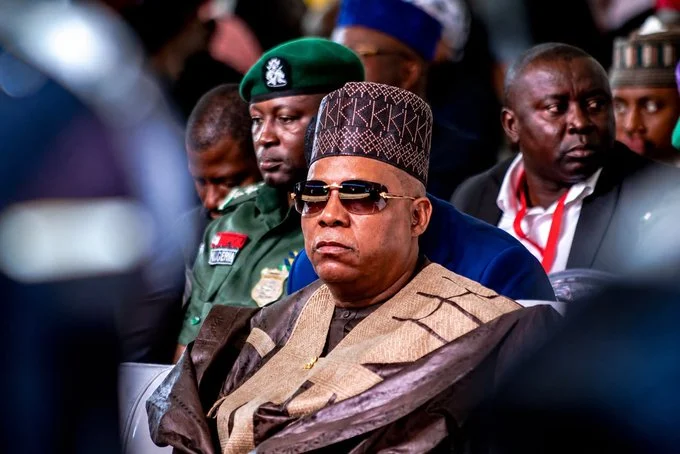
VICE-PRESIDENT Kashim Shettima deserves commendation for saying publicly what too many Nigerian leaders prefer to whisper in private. His warning that Nigeria cannot build a $1 trillion economy “on the shaky terrain of weak compliance, regulatory laxity and ethical ambivalence” is both candid and timely.
It is also an admission that the country’s greatest economic obstacle is no longer the absence of ambitious targets but the chronic failure to build institutions capable of delivering them.
In his comments at the National Corporate Governance Summit in Lagos, the Vice-President correctly identified corporate governance as the bedrock of sustainable economic growth.
His intervention is a reminder that economies do not become trillion-dollar titans through lofty declarations, policy documents or endless summits. They do so by enforcing the rule of law, protecting investors, strengthening institutions, rewarding enterprise and punishing corruption without fear or favour.
According to Investopedia, there are 21 $1tn economies in the world, with Poland and Switzerland entering the exclusive club in 2025.
The Tinubu administration has repeatedly projected Nigeria as a prospective $1 trillion economy by 2030. That ambition is commendable. But ambition is not strategy.
In 2025, Economist Bismarck Rewane warned that for Nigeria to reach that milestone by 2030, the economy would need to expand by roughly 40 per cent yearly.
Such acceleration is impossible in an environment where contracts are routinely violated, regulators are weak, public institutions are compromised, and ethical standards remain negotiable.
Shettima rightly observed that government reforms such as fuel subsidy removal, exchange-rate liberalisation and sectoral reforms merely establish the macroeconomic foundation. They do not create wealth by themselves.
Wealth is created by productive private enterprises that invest, innovate, manufacture, export, and create jobs. The government can only create the conditions for this to happen.
That is why the private sector must remain the principal engine of Nigeria’s economic transformation.
History shows that no modern economy has achieved rapid industrialisation through government spending alone.
Private capital builds factories, develops technology, finances logistics, commercialises innovation and expands productive capacity. However, private investors commit capital only where the rules are predictable, institutions are credible, and contracts are enforceable.
Unfortunately, Nigeria still falls woefully short on these fundamentals.
The Vice-President lamented that Nigeria’s corporate history is littered with spectacular failures caused not by lack of entrepreneurial ideas but by insider abuse, creative accounting, poor oversight and reckless risk-taking. He was right.
The collapse of financial institutions and large corporations over the years has consistently exposed weak boards, compromised auditors, ineffective regulators and governance structures that existed largely on paper.
For example, the banking sector crisis in 2009 destroyed jobs, eroded savings, frightened investors and weakened confidence in the wider economy.
The legal and regulatory architecture already exists. Nigeria has the Companies and Allied Matters Act, the Nigerian Code of Corporate Governance, Financial Reporting Council regulations and sector-specific governance codes issued by the Central Bank of Nigeria, the Securities and Exchange Commission and the National Insurance Commission.
The challenge has never been legislation but that of implementation.
Uto Ukpanah, President of the Institute of Chartered Secretaries and Administrators, captured this dilemma succinctly when she observed that Nigeria does not lack policies but lacks leadership commitment, ethical conduct, regulatory consistency and accountability.
That diagnosis is difficult to dispute. Nigeria has become a country where excellent policies often perish in the hands of weak institutions and inconsistent enforcement.
The country’s international governance rankings underline this institutional deficit. Nigeria placed a dismal 116th out of 180 countries in the 2025 Chandler Good Government Index, performing poorly across leadership, institutional strength, robust laws, regulatory quality and marketplace attractiveness.
Even more worrying is its ranking of 120th out of 143 countries in the World Justice Project Rule of Law Index, reflecting persistent weaknesses in judicial effectiveness, regulatory enforcement, corruption control and protection of property rights.
Although Transparency International’s latest Corruption Perceptions Index showed marginal improvement, Nigeria still languishes among the world’s most corruption-prone countries. Such rankings shape investors’ perception of risk and directly influence the cost and availability of capital.
Weak compliance destroys investor confidence because it introduces uncertainty into commercial transactions. Investors hesitate where financial statements cannot be trusted, corporate disclosures are manipulated, and regulators apply rules selectively.
Regulatory laxity encourages dishonest businesses to undercut ethical competitors through tax evasion, substandard products, insider dealings and accounting manipulation. Ethical ambivalence gradually normalises corruption until bribery, regulatory capture and conflict of interest become accepted business practices rather than punishable offences.
The consequences extend beyond individual companies. Capital becomes more expensive, foreign direct investment slows, pension funds become cautious, banks tighten lending, insurance costs rise, and businesses postpone expansion.
Productive enterprises are crowded out by rent-seekers who devote more energy to cultivating political patronage than improving productivity. The economy gradually shifts from value creation to value extraction.
These distortions are especially damaging for Nigeria because the overwhelming majority of investment required to achieve sustained high growth must come from private capital rather than government borrowing.
Potential investments lost through regulatory uncertainty, corruption or weak governance represent factories not built, jobs not created, technologies not transferred and exports not produced.
Indeed, PwC in a recent report estimated that corruption alone will account for economic losses of about 37 per cent of GDP by 2030 if not immediately curtailed.
Urum Eke, Chairman of the IoD Centre for Corporate Governance, therefore spoke an obvious truth when he argued that sound corporate governance strengthens institutions, boosts investor confidence and positions economies for long-term growth.
The lesson here is that corporate governance has become a national economic imperative, not just a boardroom affair.
Yet, while the private sector must drive growth, government cannot escape responsibility for creating the enabling environment. Indeed, one of the greatest threats to Nigeria’s $1 trillion ambition is the state’s own history of policy inconsistency, failed reforms and institutional corruption.
More than a decade after the privatisation of the Power Holding Company of Nigeria, Nigerians still suffer chronic blackouts despite billions of dollars invested by government, development partners and private operators.
The reform was meant to unleash efficiency, attract capital and expand generation and distribution.
Instead, poor due diligence, weak regulation, inadequate infrastructure, political interference and non-cost-reflective tariffs have produced a sector burdened by debt, illiquidity and chronic underperformance.
Manufacturers continue to spend enormous sums on self-generation, making Nigerian products less competitive and discouraging industrial expansion.
A country that cannot guarantee reliable electricity cannot realistically aspire to become a manufacturing powerhouse. The same governance failures are evident in railways, ports, roads and other critical infrastructure projects, where delays, cost overruns, abandoned contracts and opaque procurement practices have become routine.
The scandal surrounding the so-called Presidential Foreign Investment Promotion Council, and related controversies, further reinforce the importance of due diligence controls and accountability in public institutions.
Regardless of the eventual outcome of ongoing investigations and allegations, such episodes highlight how quickly investor confidence can be damaged when governance questions arise around institutions.
Markets thrive on certainty, credibility and trust. Once these are compromised, capital retreats.
Institutional corruption remains one of the most significant constraints on Nigeria’s development.
Money diverted through inflated contracts, procurement fraud, payroll manipulation, illicit financial flows or politically connected rent-seeking takes away spending on schools, hospitals, roads, power projects and technological innovation.
Indeed, corruption is an economic tax imposed on the entire country, not only a moral problem.
It therefore cannot be confronted by mere rhetoric or grandstanding but by intentional, deliberate and sustained action to clean up Nigeria and eliminate perhaps the biggest drag on the economy.