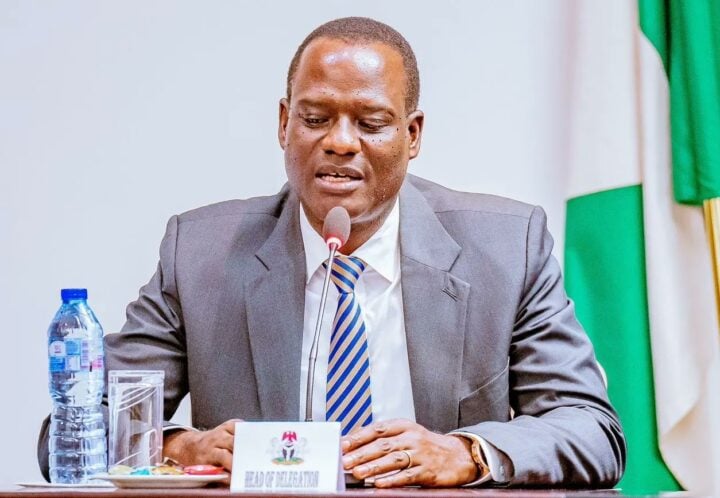
Oyedele: Tinubu Didn’t Borrow N80tn, Debt Surge Driven by FX, Legacy Liabilities
The Minister of Finance and Coordinating Minister of the Economy, Mr. Taiwo Oyedele, on Monday mounted a robust defence of President Bola Tinubu’s borrowing record, insisting that contrary to widespread public perception, the administration had not borrowed anywhere near the N75 trillion to N80 trillion being attributed to the present administration.
Instead, he explained that the sharp increase in Nigeria’s public debt was largely the result of the naira’s exchange rate adjustment, the securitisation of inherited Ways and Means advances, and refinancing of maturing obligations rather than fresh borrowing.
Oyedele spoke during a four-hour interactive session with the Senate Committee on Finance, chaired by Senator Sani Musa, where he also disclosed that the federal government generated N21.6 trillion in tax revenue between January and June 2026, representing a 49 per cent increase over the corresponding period of last year.
The meeting, which brought together the nation’s entire economic management team, turned into a searching review of the economy as senators commended improvements in revenue generation, but questioned the country’s rising debt profile, weak budget implementation, delayed capital releases and the utilisation of import duty waivers.
Providing a detailed explanation of the debt profile, Oyedele rejected claims that the Tinubu administration had borrowed up to N80 trillion.
He said, “For external loans, we always require the approval of the National Assembly. What usually happens is that once the National Assembly approves a borrowing plan, many people interpret that as money already borrowed.
the first quarter of 2026 compared with 3.13 per cent recorded in the corresponding period of 2025, with the non-oil sector accounting for much of the expansion.
He disclosed that tax collections climbed to N21.6 trillion during the first half of the year, representing a 49 per cent increase over the same period last year.
Oyedele attributed the improvement to ongoing tax reforms, increased digitalisation of revenue administration and stronger compliance.
“Allowing tax evasion to persist amounts to taxing honest taxpayers while rewarding non-compliance. That is not the kind of country we seek to build,” he said.
He also disclosed that Nigeria’s external reserves had risen above $51 billion, the highest level in 17 years, providing more than ten months of import cover, while net reserves stood at approximately $40 billion.
Although inflation remained one of the country’s most pressing economic challenges, he said coordinated fiscal and monetary measures were beginning to moderate price pressures.
He said, “Inflation remains one of our greatest macroeconomic challenges because it directly affects household welfare and purchasing power.
“However, coordinated fiscal and monetary policies are beginning to moderate inflation.”
The minister also defended the federal government’s tax incentives and import duty waivers, saying many public discussions exaggerated their fiscal cost.
The sharpest criticism, however, came from Senate Chief Whip, Senator Tahir Monguno, who questioned why rising government revenues had failed to translate into improved implementation of successive national budgets.
“If revenue performance has improved so significantly, it appears inherently contradictory that the government is still struggling to implement the budget. Where is the revenue going?” he asked.
Monguno lamented that despite impressive performances by revenue-generating agencies, the 2025 Appropriation Act had remained substantially unimplemented, compelling the National Assembly to extend its lifespan until September.
He expressed concern that implementation of the 2026 budget had also barely commenced.
He said, “The dividends of democracy are delivered through the implementation of the budget, particularly capital projects. If the budget is not being implemented, then the fundamental purpose of government is undermined.
“For example, the security of lives and property is the primary responsibility of government. Yet all the security agencies that have appeared before this committee informed us that they have received zero capital releases.
“Why is the budget not being implemented? Failure to implement an Appropriation Act amounts to a breach of the law, and such a breach is an impeachable offence,” Monguno warned.
He also demanded clarification on why about N1.7 trillion out of approximately N3.7 trillion reportedly accruing to the Federation Account in the preceding month was retained rather than distributed among the three tiers of government.
Responding, Oyedele assured lawmakers that Federation Account Allocation Committee distributions were being carried out strictly in accordance with constitutional and statutory provisions and pledged continued transparency in debt management and public expenditure.
Also speaking, Senator Adamu Aliero expressed concern over the country’s rising debt profile despite acknowledging the infrastructure projects being undertaken by the current administration.
He observed that while former President Muhammadu Buhari’s administration borrowed about N75 trillion, public estimates suggested that the Tinubu administration had borrowed between N75 trillion and N80 trillion, underscoring the need for greater public clarification on the debt figures.
Aliero also lamented that budget implementation remained well below expectations.
While acknowledging major infrastructure projects such as the Lagos-Calabar Coastal Highway and the Sokoto-Badagry Highway, he stressed that many other critical roads across the country were yet to receive adequate attention.
The committee subsequently resolved to sustain its oversight of the nation’s public finances, debt management and implementation of fiscal reforms as lawmakers sought greater accountability for improved revenues and public expenditure.