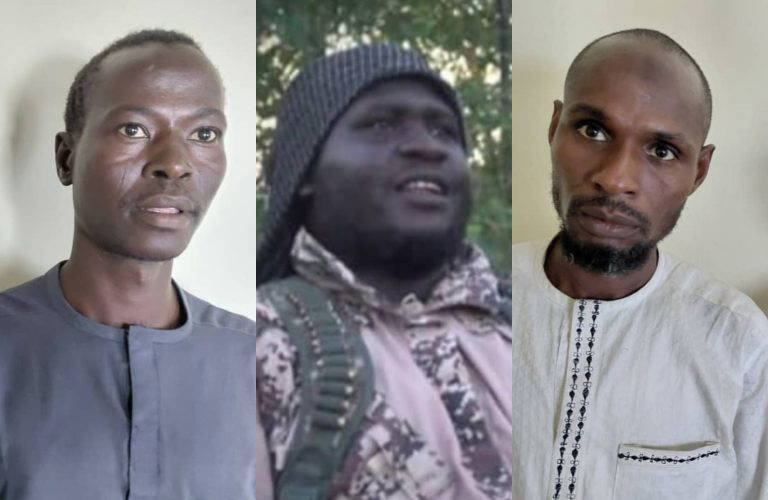
High-profile ISWAP commanders surrender as troops sustain pressure in N/East operations
By Ndahi Marama, Maiduguri
Two senior commanders of the Islamic State West Africa Province (ISWAP), identified as Ismail Mohammed and Abu Umar, have reportedly surrendered their weapons to troops of the Joint Task Force North East, Operation HADIN KAI (OPHK).
The development took place on 8 June 2026, following sustained and intensified military pressure within the theatre of operations.
Meanwhile, security sources disclosed that another prominent terrorist figure, Mohammed Khalifa, believed to be a member of the ISWAP Shura Council, was eliminated during coordinated operations conducted by OPHK forces.
Confirming the development on Thursday in an official statement, the Acting Media Information Officer of the Headquarters, Joint Task Force North East, Operation HADIN KAI, Lieutenant Colonel Haruna Sani, said troops had recorded another major breakthrough in their ongoing counter-terrorism campaign following the surrender of the two ISWAP commanders on 8 June 2026.
According to him, the surrendered fighters, Ismail Mohammed and Abu Umar, are currently in military custody where they are undergoing proper profiling and debriefing.
He explained that preliminary findings showed both men held key leadership roles within the group’s hierarchy and operated around the Mangari axis of the Lake Chad region.
Sani noted that Ismail Mohammed was a close ally of a senior ISWAP leader, Baa Shuwa, and had in-depth knowledge of the group’s command structure and operational activities.
He added that Abu Umar was known within the terror network as an expert in explosives, responsible for the production and servicing of vehicle-borne improvised explosive devices (VBIEDs) and other combat support equipment used by the group.
Further interrogation, he said, confirmed that Mohammed Khalifa, a high-ranking ISWAP operative and member of its Shura Council, was killed during the joint military operations.
He stressed that the surrender of the two commanders marked a significant blow to the terrorist organisation, given their long-standing experience, influence, and technical roles within the insurgency.
Sani further stated that their decision to surrender reflected the growing effectiveness of sustained military offensives by Operation HADIN KAI, supported by allied forces conducting precision strikes against terrorist hideouts across the region.
He added that continuous pressure from these operations has steadily weakened terrorist capabilities, disrupted their networks, and forced an increasing number of fighters to give up.
According to him, the development also highlights the rising desperation and declining morale among insurgents as they lose freedom of movement and safe havens.
He reaffirmed that Operation HADIN KAI remains fully committed to maintaining relentless pressure on terrorist elements, with ongoing efforts aimed at dismantling their leadership structure and restoring lasting peace to affected communities.