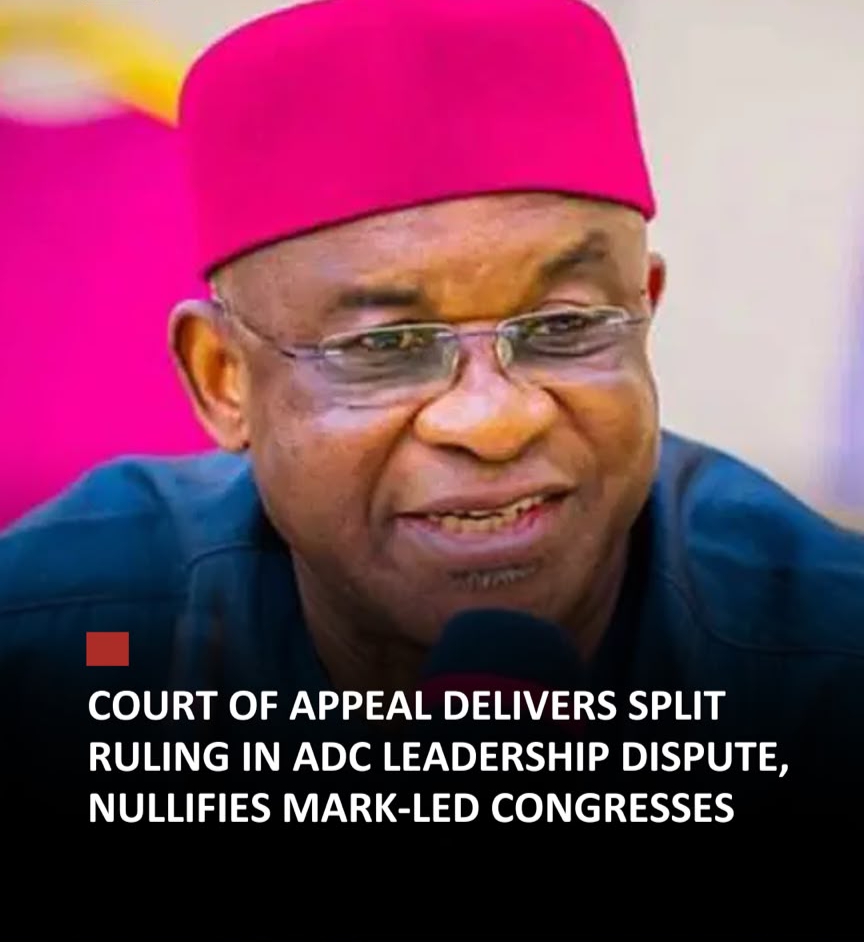
Court of Appeal Delivers Split Ruling in ADC Leadership Dispute, Nullifies Mark-Led Congresses
In a 2-1 majority decision, the Court of Appeal has nullified the state congresses and national convention conducted by the Senator David Mark-led National Caretaker Committee of the African Democratic Congress (ADC).
The court affirmed a Federal High Court ruling that only the existing state executives — and not the National Caretaker Committee — have the constitutional power to conduct valid state congresses in the party.
Delivering the lead judgment, Justice Okon Abang held that the National Caretaker Committee’s suspension of state party structures breached the ADC’s constitution and the Electoral Act. He emphasised that the matter is not a mere internal party affair, stating that “internal democracy is not a slogan” and that those seeking to govern must act within the law.
Justice Abang referenced Supreme Court precedents, including PDP v. Nwachukwu and PDP v. Lamido, to affirm the court’s jurisdiction to intervene. The justices criticised the appointment of congress committee members while the four-year tenure of the duly elected state executive committees remained valid.
The court awarded N10 million in costs against the ADC in favour of Don Norman Obinna (Abia State ADC Chairman) and six other state chairmen. Justice Donatus Okorowo aligned with the majority decision.
In his dissenting judgment, Justice Abba Mohammed held that the Federal High Court erred by delving into the internal affairs of a political party. He ruled that Justice Joyce Abdulmalik lacked jurisdiction, describing the suit as an appeal over internal party issues.
Justice Mohammed further noted that the plaintiffs (the seven ADC state chairmen) failed to exhaust the party’s internal dispute resolution mechanisms before approaching the Federal High Court.
He criticised the trial court for failing to fully consider Articles 19(12) and 19(14) of the ADC constitution, which empower the National Working Committee (NWC) and National Executive Committee (NEC) to dissolve state structures when necessary and appoint caretaker committees.
Justice Mohammed described the Federal High Court’s decision as “perverse” and “fragmented” for ignoring other provisions that limit state executive committees primarily to preparing agendas for congresses rather than conducting them.