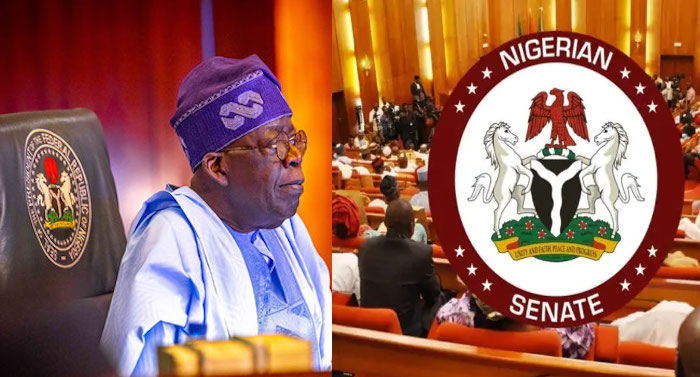
Senate Urges Tinubu To End Boko Haram Reintegration, Adopt Tougher Anti-Terror Measures
By Sunday Aborisade
Senate, on Tuesday , asked President Bola Tinubu to immediately halt the federal government’s policy of rehabilitating and reintegrating former Boko Haram insurgents into society.
It declared that the worsening wave of terrorism, banditry, and kidnappings across the country required tougher measures rather than what lawmakers described as policies that rewarded former insurgents.
The upper chamber also mandated its leadership to seek audience with Tinubu to formally present Senate’s concerns over the deteriorating security situation and press for more decisive actions to stem the tide of violent attacks nationwide.
The resolutions followed a motion of urgent national importance sponsored by Chairman of Senate Committee on Army, Abdulaziz Musa Yar’Adua, on the escalating attacks, abductions, and killings of serving and retired military personnel across the country.
The senate urged the federal government to ensure that terrorists, bandits, and other violent criminals were arrested and prosecuted, instead of being rehabilitated.
It observed a minute silence in honour of late Major General Rabe Abubakar and other Nigerians who had lost their lives to terrorism, insurgency, banditry, and kidnapping.
It also resolved to constitute a delegation of senators to visit the family of the late military officer, Katsina State Government, and Nigerian Army to convey its condolences.
The chamber commended members of the armed forces and other security agencies for their sacrifices in defending the country, while calling for improved intelligence gathering, stronger inter-agency collaboration, wider community participation, and accelerated deployment of modern security technologies, including unmanned aerial systems, geospatial intelligence, and integrated command-and-control platforms.
The call to discontinue the rehabilitation programme was introduced by Joseph Ikpea, who stated that the policy had become a source of national concern.
Ikpea stated, “My additional prayer is that the issue of insecurity has become something Nigerians are deeply concerned about.
“One of the issues we need to look at is the rehabilitation of Boko Haram members. My additional prayer is to stop the rehabilitation of Boko Haram.”
His proposal received overwhelming support and was seconded by Adams Oshiomhole.
Backing the proposal, Oshiomhole described the rehabilitation policy as illogical at a time when victims of terrorism and families of fallen security personnel continued to bear the painful consequences of insurgent attacks.
Earlier, while moving the motion, Yar’Adua described Nigeria’s security crisis as increasingly complex, persistent, and alarming.
He stated that criminal groups had become more sophisticated by deliberately targeting serving and retired military officers.
The senator said the recent abduction and death of Abubakar, a former Director of Defence Information, highlighted the dangerous evolution of insecurity in the country.
“The death of Major General Rabe Abubakar and others in terrorists’ custody represents not only a personal tragedy but a painful national loss demanding urgent action,” Yar’Adua said.
According to him, retired military officers are vulnerable because of the sensitive operational, intelligence, and command responsibilities they handled during service, making them attractive targets for terrorists, kidnappers, and bandits.
He warned that sustained attacks on military personnel undermined troop morale, weakened public confidence in the state’s ability to protect its citizens, and emboldened criminal groups.
Supporting the motion, Osita Izunaso described the recurring attacks on military personnel as disturbing and unacceptable.
“This motion has come at the right time when Nigerians expect the nation’s defence and security architecture to decisively confront growing insecurity,” he said.
Equally contributing, Abdul Ningi called for more rigorous legislative oversight of the country’s security institutions, urging the National Assembly to scrutinise casualty records, operational responses, and support provided to families of fallen security personnel.
Presiding over the session, Deputy Senate President Jibrin Barau acknowledged the concerns raised by senators but urged a balanced assessment of ongoing military operations.
According to him, terrorism remains a global challenge affecting many countries, particularly within the West African sub-region, and requires coordinated regional responses.
“Our men and women in uniform are doing their best. They have been successful in decimating many criminal elements and deserve our continued support,” Barau said.