Senate passes State Police Bill: It’s now Federal, State Police Service
By Henry Umoru, Assistant Politics Editor
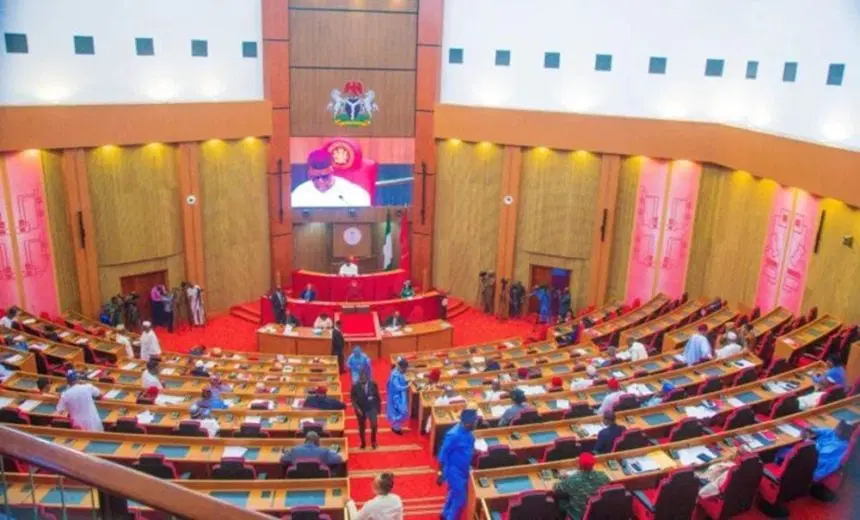
ABUJA — In a historic move set to reshape Nigeria’s security architecture, the Senate on Wednesday passed a constitutional amendment bill providing for the establishment of state police services in all 36 states of the federation.
The landmark legislation, forwarded to the National Assembly by President Bola Tinubu, paves the way for the replacement of the long-standing centralized policing structure with a dual system comprising the Federal Police Service and separate State Police Services.
The passage of the bill was briefly delayed after the Senate’s electronic voting system malfunctioned for more than 30 minutes, forcing lawmakers to resort to manual voting. In a rare development, all 88 senators present cast their votes through a show of hands.
As engineers worked to restore the voting platform, Senate Leader Opeyemi Bamidele (APC, Ekiti Central) moved a motion for the chamber to abandon the electronic process and proceed manually. The motion was seconded by Senate Minority Leader Abba Moro (PDP, Benue South), allowing the Senate to continue with the voting process.
Safeguards Against Abuse
To address concerns that governors could misuse state police for political or ethnic purposes, the constitutional amendment introduces strict oversight mechanisms and accountability measures.
According to the report of the Senate Committee on the Review of the 1999 Constitution, chaired by Deputy Senate President Jibrin Barau (APC, Kano North), no state will be permitted to establish a police service unless it meets nationally prescribed standards certified by the National Assembly.
Under the amended Section 214 of the Constitution, the Federal Police Service will retain exclusive authority over critical security matters, including national security, terrorism, cybercrime, arms trafficking, interstate crimes, international criminal networks, as well as policing the Federal Capital Territory (FCT) and federal institutions.
While state police services will be responsible for maintaining public safety within their jurisdictions, they will not be allowed to operate outside their state boundaries except where specifically authorized by an Act of the National Assembly.
The amended section states that each state may establish a State Police Service through legislation passed by its House of Assembly, provided it satisfies the required national standards before becoming operational.
Conditions for Federal Intervention
One of the major provisions of the bill grants the federal government the authority to temporarily assume control of a state police service under exceptional circumstances.
The President may intervene where public order has broken down or is about to collapse and the state police is unable or unwilling to respond effectively. Intervention may also occur where a state police service becomes incapacitated due to serious administrative, financial, or operational challenges.
The bill further permits federal action where there is substantial evidence that a state police service is being used to violate fundamental rights, intimidate political opponents during elections, persecute groups on ethnic or religious grounds, or obstruct constitutional governance.
Any intervention must be authorized in writing by the President, clearly stating the reasons, affected area, and duration. Notices of such action must be sent within 48 hours to the state governor, the Speaker of the State House of Assembly, the National Police Council, and the National Assembly.
The legislation also provides safeguards against prolonged federal control by requiring Senate approval and allowing courts to review the legality, scope, and duration of any intervention.
High-Profile Attendance
The significance of the debate attracted several prominent political figures to the Senate gallery.
Among those present were the President’s Chief of Staff, Femi Gbajabiamila; Kaduna State Governor Uba Sani; Ogun State Governor Dapo Abiodun; and Ondo State Governor Lucky Aiyedatiwa.
They were joined by attorneys-general from several states, including Anambra, Akwa Ibom, and Ondo, as well as the Director-General of the Nigeria Governors’ Forum (NGF), Dr. Abdullateef Shittu.
Bamidele Defends Decentralised Policing
Leading debate on the bill, Senate Leader Bamidele argued that Nigeria’s highly centralized policing system has become overstretched and ineffective in addressing local security challenges such as banditry, kidnapping, and communal conflicts.
According to him, the creation of state police services alongside the federal police aligns with the principles of true federalism by enabling state authorities to respond more effectively to security threats using local knowledge and intelligence networks.
### Protection for Police Leadership
The amendment also introduces measures aimed at protecting police leadership from political interference.
The Federal Police Service will be headed by an Inspector-General of Police appointed by the President on the recommendation of the National Police Council and subject to Senate confirmation.
At the state level, Commissioners of Police will be appointed by governors based on recommendations from the National Police Council and confirmed by the respective State Houses of Assembly.
The bill stipulates that neither the Inspector-General nor a State Commissioner of Police can be removed arbitrarily. Any removal must be based on established grounds, follow due process, and receive approval from a two-thirds majority of either the Senate or the relevant State House of Assembly.
In addition, the amendment expressly prohibits political authorities from directing police services to target specific individuals, political parties, associations, or groups outside the bounds of the law. It also forbids the use of police powers to suppress lawful political activities or to pursue partisan, ethnic, religious, sectional, or personal interests.