Nigeria raises AI concerns at ILC
By Victor Ahiuma-Young, Geneva, Switzerland
As artificial intelligence (AI) continues to transform workplaces worldwide, governments are facing a critical challenge: how to harness technological progress without compromising jobs, workers’ rights, and economic inclusion.
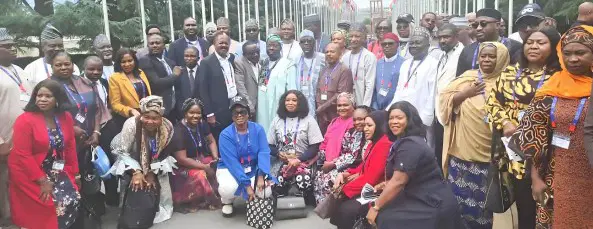
Speaking at the 114th Session of the International Labour Conference (ILC) in Geneva, Nigeria joined other nations advocating for a people-focused approach to the future of work. The country cautioned that unregulated AI adoption could widen social inequalities and lead to large-scale job losses.
Leading Nigeria’s delegation, the Minister of Labour and Employment, Dr. Muhammad Dingyadi, urged governments and stakeholders to maintain a balance between technological innovation and worker protection. He emphasized that decisions taken today would shape whether AI enhances or diminishes the value and dignity of labour in the future.
According to Dingyadi, rapid advancements in AI are driving significant changes across economies and labour markets, creating both opportunities and challenges.
“The world is advancing rapidly through artificial intelligence, and we must embrace these developments. While AI offers enormous benefits, we must also remain mindful of the uncertainties and risks associated with its growth,” he said.
The minister noted that the International Labour Organisation’s (ILO) report highlighted ongoing changes, including expanding labour markets, evolving work structures, new employment relationships, and technological innovations influencing policy development. While these developments present major advantages, they also raise concerns about job security and workforce stability.
He explained that although AI can generate new employment opportunities, it could also replace existing jobs. Likewise, the expansion of digital and technological infrastructure may reduce the importance of traditional roles and human contributions in the workplace.
“We must adopt a balanced strategy that allows us to benefit from AI without reversing the progress achieved in promoting decent work and fair labour standards,” he stated.
Dingyadi further disclosed that the Federal Government recognized the transformative potential of AI early enough, leading to the creation of the Federal Ministry of Communications, Innovation and Digital Economy to drive Nigeria’s digital transformation agenda.
He stressed that aligning AI development with national priorities would enable the country to enjoy technological benefits while safeguarding decent work opportunities.
“This is a defining moment. The decisions we make today will determine whether technological progress strengthens or weakens the dignity of labour for future generations,” he added.
Labour Warns Against Worker Exploitation
Meanwhile, organised labour has expressed concerns that unchecked AI deployment and platform-based business models could threaten workers’ rights and increase job insecurity globally.
President of the Nigeria Labour Congress (NLC), Joe Ajaero, made the remarks during discussions on the future of work at the conference. He warned that without proper regulations, technological advancements could reduce workers to disposable assets within the labour market.
Ajaero said the labour movement appreciated the Director-General’s focus on AI and the Future of Work under the Global Coalition for Social Justice, as well as the intervention of Nigeria’s Labour Minister.
However, he stressed that technology is not inherently neutral and can be used in ways that negatively affect workers.
“When left unregulated, AI and platform-based business models can encourage insecure employment, automate exploitation, weaken accountability, and suppress wages under the banner of innovation,” he said.
According to him, relying solely on voluntary corporate regulations could hand over the future of work to forces that have historically undermined workers’ dignity.
“The choice before us is simple: either we establish enforceable international standards that effectively manage AI-related risks while maximizing its benefits, or we continue toward a future where machines increasingly dictate workplace conditions and workers become expendable.
“We choose the first option and are prepared to defend it,” Ajaero declared.
NSITF Takes Steps to Safeguard Workers
The Nigeria Social Insurance Trust Fund (NSITF) has also announced efforts to protect workers from emerging challenges associated with the digital economy.
Speaking in Geneva after the minister’s presentation, NSITF Managing Director, Oluwaseun Faleye, revealed that the organisation is focusing on issues linked to AI, platform-based employment, and the expanding gig economy.
Commending the minister’s position, Faleye described it as a comprehensive response to emerging workplace realities.
“One of the major issues within the labour ecosystem today involves platform workers, the gig economy, and the impact of AI on employment and workers generally,” he said.
He noted that AI is becoming a permanent feature of modern workplaces, making it essential for governments and institutions to understand its implications and develop effective policy responses.
Faleye explained that digital platforms, remote work arrangements, and app-based services have significantly altered traditional employment patterns, creating fresh challenges for labour regulators and social protection institutions.
Workers operating through ride-hailing and delivery platforms now constitute a substantial part of the workforce, making it necessary to redefine conventional employment concepts and workplace engagement standards.
“Labour has traditionally been viewed within the framework of the formal workplace. However, technological innovations now allow people to work remotely or through platforms such as Uber and Bolt. We need appropriate mechanisms to assess their contributions and determine how best to fulfill our mandate within these changing realities,” he said.
He added that one of the key challenges involves determining when an injury suffered by a remote or platform worker qualifies as a workplace-related incident.
“For workers operating from home, we must establish clear guidelines to determine whether an injury is connected to work activities or other circumstances,” he noted.
Faleye expressed confidence that ongoing engagements with stakeholders at international forums such as the International Labour Conference would help shape policies capable of addressing these challenges and extending social protection coverage to workers beyond the traditional employment system.